Accounting advisory in Spain: what it does and costs

by Ivor Padilla
Co-Founder & Engineering Director

Accounting advisory in Spain: what it does and costs
If you are a freelancer or small business owner in Spain trying to work out whether you need an accounting advisory (asesoría contable), or if you run a practice and want to understand where your team's hours actually disappear every month, this is the post for you. The service is widely used but poorly explained, and it is routinely confused with two adjacent services (gestoría and asesoría fiscal) that do related but distinct work.
This article answers the practical questions circulating in expat business groups, UK-based accountants with Spanish clients, and the practices themselves: what does an asesoría contable actually do, what does the law require, what does it cost, and why does every mid-sized firm in Spain lose so many hours on the last three days of the month?
TL;DR: A Spanish asesoría contable keeps a business's books in order under Spain's Commercial Code and General Accounting Plan, prepares quarterly and annual tax filings, and files annual accounts with the Companies Register. The mandatory records are the day journal and the inventory/annual-accounts book (Art. 25 Commercial Code); annual accounts must be prepared within three months of year-end (Art. 253 Corporate Entities Law) and filed within a month of shareholder approval (Art. 279). Fees for most SMEs fall in a 60–400 €/month band, depending on volume and complexity. The real bottleneck is not the accounting itself. It is the flood of client documents arriving in the last three days of each month, often as unlabeled PDFs or WhatsApp photos.
What an accounting advisory actually is (and how it differs from a gestoría)
The words asesoría contable, gestoría and asesoría fiscal are often used interchangeably in Spain. They are not the same service.
An accounting advisory (asesoría contable) keeps a business's books in line with Spain's accounting standards: it records every transaction, prepares periodic balance sheets and profit-and-loss statements, reconciles bank accounts, and produces the annual accounts that a company must file with the Companies Register (Registro Mercantil).
A gestoría is broader and more administrative. It handles payroll, social security filings (TGSS), Hacienda forms, traffic-related paperwork, and any form-based interaction with Spanish public administration. Many small Spanish practices trade under the name "gestoría" but in fact deliver asesoría contable as part of their service. The labels on the office door are not a reliable guide.
An asesoría fiscal specialises in tax: VAT filings (modelo 303), IRPF withholding forms (modelo 111/115), corporate income tax (modelo 200), tax planning, and defence before the Agencia Tributaria if there is an inspection. In practice, most Spanish SMEs buy all three services as a package from the same practice, because they share the same underlying transaction data.
A rough decision guide for a business owner:
| If you need... | You want... |
|---|---|
| Books kept, accounts prepared, annual accounts filed | Asesoría contable |
| Payroll, TGSS, administrative filings | Gestoría |
| Tax returns, tax planning, inspection defence | Asesoría fiscal |
| All of the above (most SMEs) | A combined practice (most offer this) |
One firm can do all three. Ask what is included before you sign.
What an accounting advisory does, month by month
The work of an asesoría contable follows a calendar that almost every Spanish practice recognises. Understanding the rhythm helps you see both what you are paying for and where the pressure points live.
| Period | Task | Deadline |
|---|---|---|
| Monthly | Receive and record invoices, bank reconciliation, internal management reporting | End of each month |
| Quarterly | VAT return (modelo 303), IRPF withholdings (modelo 111/115), IRPF instalments (modelo 130 for freelancers) | AEAT filing window after each quarter (consult current AEAT calendar for exact dates) |
| Annual | Year-end close, annual accounts, corporate income tax (modelo 200), filing at the Companies Register | July (for calendar-year IS) and within one month of accounts approval |
The quarterly IVA cycle is one of the most demanding recurring tasks. Our companion guide to modelo 303 in 2026 explains the form in detail and the changes introduced by the latest AEAT order.
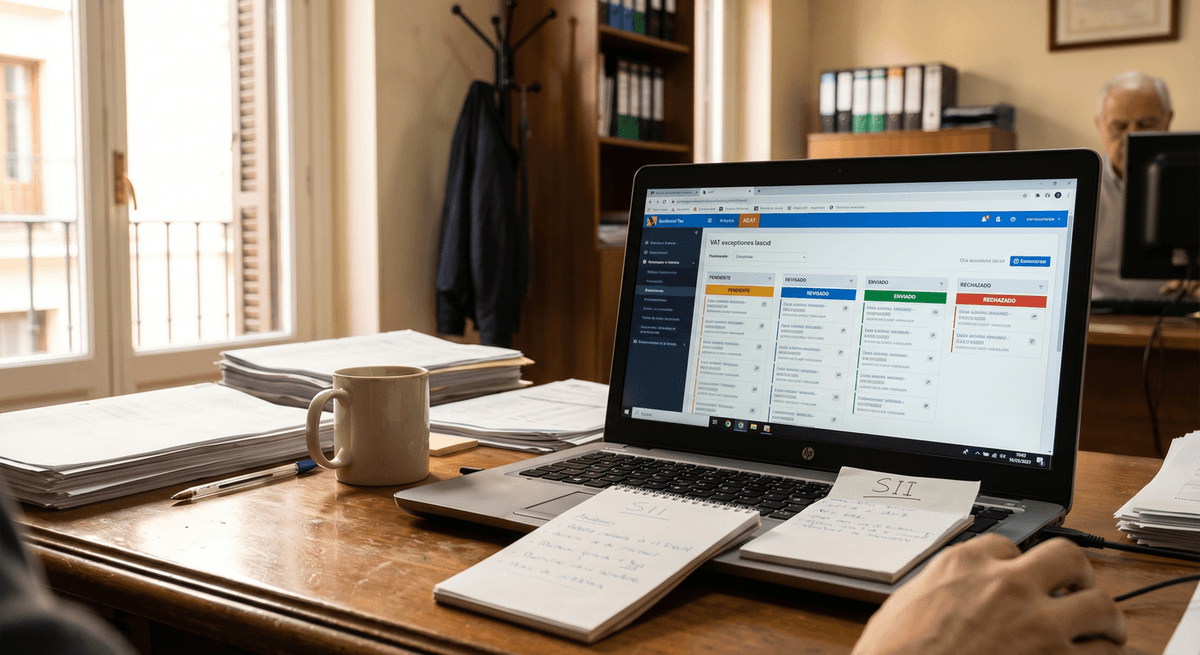
The monthly close is where most of the actual hours go, and where the bottleneck typically lives. In theory it should be smooth: the client sends their invoices and receipts on an agreed schedule, the accounting technician books them, reconciles the bank statement, prepares a simple management report. In practice, most of the client documentation lands in the last three days of the month, in assorted formats, and the entire first week of the following month is absorbed in just making that data usable before any real accounting can be done.
Accounting obligations in Spain: what the law requires
Every business operating in Spain, whether as a company or a self-employed individual, sits inside four overlapping legal frameworks that define what records must exist, how long they must be kept, and when they must be filed. An asesoría contable's job is to make all of these happen without you thinking about it.
The core obligation: keeping orderly books
Spain's Commercial Code (Art. 25) requires all business owners to maintain orderly, chronological accounting records. The mandatory minimum records are the day journal (libro diario) and the annual inventory and accounts book (libro de inventarios y cuentas anuales).
The day journal captures every transaction in chronological order. The inventory and annual accounts book groups those transactions into the periodic balance sheets and the full set of annual accounts at year-end. Companies typically also keep a general ledger (libro mayor), a VAT-records book, and sector-specific registers, but the two named above are the irreducible legal minimum.
Legalising the books at the Companies Register
Article 27 of the Commercial Code requires business owners to file their mandatory accounting records with the Companies Register (Registro Mercantil) in their jurisdiction for legalisation. Electronic books may be used and must be registered no later than four months after the financial year ends.
For calendar-year companies, that means the electronic books for the previous year must be submitted to the Companies Register by the end of April. Most practices handle this as a discrete annual task bundled with the year-end close.
Retention: six years, even after closure
Article 30 of the Commercial Code requires business owners to keep all accounting records, correspondence, and supporting documents for six years from the date of the last entry. This obligation continues even if the business ceases operations.
This is one of the reasons document storage is not trivial. A sole trader who closes a business today still has to keep six years of records. For more detail on how this commercial obligation intersects with other retention regimes (tax, VAT invoicing, GDPR), see our piece on document management for professional firms in Spain.
Annual accounts: formulation and filing
Article 253 of Spain's Corporate Entities Law (Ley de Sociedades de Capital) requires company directors to prepare annual accounts, a management report, and a profit appropriation proposal no later than three months after the financial year ends.
Article 279 of the Corporate Entities Law requires company directors to file the approved annual accounts with the Companies Register (Registro Mercantil) within one month of shareholder approval.
For a calendar-year Spanish SL, that produces a familiar sequence: year-end on 31 December, draft accounts by the end of March (the three-month window under Art. 253), shareholders' approval meeting thereafter, accounts filed with the Companies Register within one month of approval (Art. 279). Missing the filing deadline can have registration consequences, so seek advice from your advisor if you are approaching the deadline.
Which accounting framework applies
Spain's General Accounting Plan (Plan General de Contabilidad, via Royal Decree 1514/2007) applies to all businesses regardless of legal structure. Small and medium enterprises have the option to use a simplified version.
Most SMEs use the PGC for Small and Medium Enterprises (PGC de PYMES), which is structurally identical but with reduced disclosure requirements. The choice is not usually a discretionary decision: it depends on size thresholds and operational complexity, and the asesoría contable will advise which regime applies.
If you are self-employed (IRPF)
Article 68 of Spain's Personal Income Tax Regulations requires self-employed professionals and small business owners in the standard estimation regime to maintain full accounting records per the Commercial Code. Those in the simplified regime may use simplified registers for sales, purchases, and capital assets.
In practice, this means that a freelancer on estimación directa normal has the same bookkeeping obligations as a small company: day journal, inventory and annual-accounts book, and everything the Commercial Code requires. Most freelancers, however, are on estimación directa simplificada, which allows a lighter set of registers: typically the sales ledger, the purchases ledger, and a capital assets register. The minority on estimación objetiva (módulos) have still lighter requirements. The distinction is important because it determines what kind of accounting support a sole trader actually needs.
What an accounting advisory costs in Spain
Any honest answer to this question is a range, not a number. Any practice quoting a precise figure without asking about volume is usually either under-scoping or preparing to charge extras later. As an indicative guide for typical 2026 market rates, and only as an indication:
- Self-employed on estimación directa simplificada (low invoice volume, no employees): roughly 60–120 €/month, depending on the number of monthly invoices and whether the practice is handling quarterly tax returns as part of the price.
- Small SL (annual revenue under ~500,000 €, <5 employees, straightforward operations): roughly 150–300 €/month for combined accounting, tax and payroll services.
- Medium SL (annual revenue 500K–3M €, complex operations, multiple employees, inventory): 300–600 €/month and upwards, with the upper end reflecting more frequent reporting, inventory movements, or cross-border transactions.
What drives the price up is rarely the complexity of the accounting entries themselves, which are routine. It is usually:
- Volume: a business generating 40 invoices a month costs significantly less to keep than one generating 400.
- Messiness of incoming data: a client who delivers a clean monthly summary in Excel is cheaper to serve than one who sends loose WhatsApp photos of tickets the day before the filing deadline.
- Complexity of operations: inventory, multi-currency, intra-community transactions, operations with related parties, and deferred tax assets all add time.
- Response expectations: clients who expect same-day replies on accounting questions are paying for availability, not just compliance.
The most useful way to compare quotes is to ask what exactly is included per month, what is billed separately, and how the practice handles year-end and inspection defence. A lower headline rate with a long list of add-ons is rarely cheaper.
Five criteria that actually matter when choosing an accounting advisory
With many thousands of accounting practices across Spain, filtering a shortlist down to one is usually a matter of these five questions:
- Do they understand your sector? A restaurant's accounting has almost nothing in common with a SaaS consultancy's. Look for a practice with at least a handful of comparable clients in your industry.
- Can they integrate with your invoicing tool? If you already use Holded, A3, Contasimple, Billin or another mainstream tool, ask whether the asesoría works directly inside it or expects you to export CSV files for them every month. The difference is dozens of hours per year.
- How quickly do they reply? On routine queries a two-day reply is reasonable; on urgent matters (an AEAT notification, a payment deadline, an inspection) you need same-day. Ask clients, not the practice itself.
- Who represents you before Hacienda if there is an inspection? Tax inspection defence is a distinct professional skill and not every accounting practice is well equipped for it. If a practice's answer is vague, assume they outsource or do not handle it at all.
- Transparent pricing or billable hours? Fixed monthly retainers with a clear scope are almost always easier to manage than hourly billing. Firms that charge by the hour tend to generate arguments over what is included and what is not.
Ultimately, the relationship with your asesoría is one of the longest professional relationships most business owners maintain, often longer than their relationship with a specific bank. Getting the fit right matters.
Where the real hours go: the month-end document flood
In almost every asesoría contable we have worked with, the accounting software is well configured, the team is trained, the closing procedures are clear. The actual bookkeeping (a recurring purchase invoice, a payroll entry, a VAT reclassification) takes minutes per item.
Where time disappears is on the last three days of each month. That is when clients send in their paperwork: invoices for the month, bank statements, petty cash receipts, administrator's payslip. The delivery arrives as a ZIP with filenames like IMG_20260328.jpg, as a single PDF with 30 scanned invoices concatenated together, as a WhatsApp message with photos, or as an email thread the client forwarded at midnight. The accountant then has to open each document, identify what it is (received invoice, issued invoice, bank statement, expense claim), extract the key fields (supplier, tax ID, amount, date, concept), verify the VAT treatment, assign it to the correct accounting code and import it into the accounting software, all before the first closing entry can even be made.
The move toward mandatory B2B electronic invoicing in Spain, first through the Crea y Crece framework (see our full analysis for the legislative detail) and now through its implementing regulation (see our companion piece on B2B e-invoicing), is intended to fix part of this problem upstream, by forcing invoices into structured machine-readable formats that can be ingested automatically. In the meantime, most accounting practices in Spain are still dealing with a mixed reality of paper, PDFs, and structured e-invoices coexisting in the same client portfolio.
This is the bottleneck that genuinely deserves attention. The answer is not to replace the accountant. Their professional judgement on periodisations, provisions, related-party transactions and temporary tax differences is irreplaceable. The answer is to stop having the accountant manually open and classify thirty PDFs in the first week of every month.
Frequently asked questions
How is an asesoría contable different from a gestoría?
An asesoría contable specialises in accounting: keeping the books, preparing financial statements, filing annual accounts. A gestoría is broader and handles administrative paperwork (payroll, TGSS, Hacienda forms, traffic-related filings). Most Spanish practices sell both services under the same roof, but the technical work is distinct.
Am I legally required to keep accounts if I am self-employed in Spain?
Yes, but the requirements vary by tax regime. If you are on estimación directa normal, you must keep full accounting records under the Commercial Code. If you are on estimación directa simplificada, simplified registers for sales, purchases and capital assets are sufficient. If you are on estimación objetiva (módulos), the requirements are lighter still but you still need basic registers. Art. 68 of the IRPF regulation sets the detailed rules.
When do I need to file my annual accounts at the Companies Register?
Within one month of the shareholders' meeting that approves them. For a calendar-year company, that typically means draft accounts by the end of March (within three months of year-end under Art. 253 LSC), shareholder approval thereafter, and filing at the Companies Register within one month of approval under Art. 279 LSC.
How long do I have to keep accounting records?
Six years from the date of the last entry, under Art. 30 of the Commercial Code. This obligation continues even if the business ceases operations. Keep in mind that tax records have a separate retention period under Spanish tax law, and if the stacks overlap, the longer one governs in practice.
Can my asesoría contable represent me before Hacienda if I am inspected?
Yes. Most asesorías in Spain either represent clients directly in tax inspections or coordinate with an asesoría fiscal that does. Ask at the engagement stage exactly how the practice handles inspections, whether it is included in the monthly fee or charged separately, and whether they have direct experience defending clients.
How will the new e-invoicing rules change my asesoría's work?
Structurally. Today the accountant spends a significant share of the month chasing, opening and classifying unstructured client documents. Mandatory structured B2B e-invoicing (see our dedicated guide to the implementing regulation for the dates and scope) will, over time, move most B2B invoices into a standard machine-readable format that an accounting system can ingest automatically. The short-term reality is mixed: some clients will send structured invoices, others will still send PDFs, and the transition will be phased in gradually.
How we are approaching this at Gradion
In the asesorías contables we have worked with, our focus is not on the accounting itself. It is on the intake and pre-classification of client documents, which is where most of the monthly close time actually goes.
In the pilots we have run with Spanish accounting practices specifically (a narrower population than the all-firm-types figure reported in our document-management analysis for professional firms), roughly 40 to 60 per cent of a technician's total time in the two weeks before a monthly close is not spent making accounting entries. It is spent chasing, opening and classifying documents that the client sent in the wrong format, without descriptive filenames, or concatenated into a single PDF. The accounting itself is routine; the preparation is the bottleneck.
What we automate is the intake and pre-classification of the client's document package. We connect to the client's inbound channels (email, shared folders, WhatsApp Business if they use it), pre-classify each document against the client's actual accounting categories, extract the key fields (issuer tax ID, base amount, VAT, date, invoice number), and present the pre-structured result directly inside the accounting software the team is already using. The accountant does not change software. They simply stop opening PDFs one at a time. In the projects we have run, most of that preparation load is removed from the accountant's close-week, returning the hours the 40-60 per cent figure above represents back to professional judgement work.
This is augmentation, not replacement. The professional judgement (periodisations, provisions, related-party transactions, temporary tax differences) stays with the accountant. What changes is how much of the team's attention is absorbed by document handling before any of that judgement is applied.
If your practice recognises this pattern in its own month-end, the conversation starts here.
Is your team losing hours every week to document chaos before the close?
We resolve it in 10 days, with a fixed-price pilot.
Tell us about your case →